
You want to study Arabic online at university level — not through random apps or 3-minute videos, but for real.
You’re ready for structure, academic depth, and a certificate or credential that actually means something in the real world.
Good. This guide covers exactly that. No recycled advice, no generic lists. Just a clear breakdown of what university-level Arabic study actually looks like online, where to find it, and how to choose the right path for your goals.
Do you dream of studying university-level Arabic with native Arabic speakers from Egypt? Here you will learn all the Arabic language skills, including professional reading and writing. It’s a comprehensive curriculum to become a professional, as if you were living in Egypt or another Arab country. There’s no need to think twice; this is the path to diligent online study.
Why Study Arabic Online University Level?

Let’s be honest about something.
Self-teaching Arabic sounds manageable — until you hit verb conjugations, root systems, and sentence structures that genuinely require guidance to untangle. Most people who quit Arabic online didn’t quit because Arabic is impossible. They quit because they had no system.
University-level Arabic study fixes that. Here’s why it’s different from the usual online approach:
Structured learning from day one. From the alphabet through to academic writing, everything is mapped out in sequence. No drifting. No guessing what to study next.
Global access. You can study from London, Kuala Lumpur, Chicago, or Cairo — without relocating or reshaping your entire life around a schedule.
Academic credibility. University-level content gives you the kind of linguistic depth that actually shows up on your CV, in job applications, and in academic settings.
Real flexibility. Study when it works for you, without sacrificing quality or falling behind.
Certified outcomes. Walk away with credentials that open actual doors — not just digital badges from a quiz app.
Here’s the thing most guides don’t say: you don’t have to enroll in a formal university to get university-level Arabic training. The right online academy can give you the same depth, the same structure, and verified certificates — at a fraction of the cost and time commitment.
More on that below.
What Type of Arabic Will You Study at University Level?

University-level Arabic programs aren’t one-size-fits-all. The type of Arabic you study depends entirely on your goals.
Modern Standard Arabic (MSA)
This is the linguistic backbone of formal Arabic. Used across news media, literature, legal documents, academic publishing, and all formal communication throughout the Arab world. If you’re studying Arabic for academic research, journalism, diplomacy, or any professional setting, MSA is non-negotiable.
The Arabic Language (Fusha) complete guide breaks down exactly what MSA mastery involves — including realistic timelines. Honest answer: expect 2–4 years of consistent study to reach advanced proficiency.
Classical Arabic (Quranic Arabic)
The language of the Quran, classical Islamic scholarship, historical poetry, and theological texts. If you’re studying Islamic sciences, religious history, or classical literature, this is your focus. It shares roots with MSA but requires separate specialized study.
Arabic Literature & Linguistics
The deepest academic track. You’ll study sentence structure, rhetoric, morphology, and the philosophical roots of Arabic thought. This is the university department track — ideal for people going into academia, translation, or serious research.
Arabic for Professional and Business Contexts
A university-level but practically focused track. Covers formal vocabulary, business correspondence, negotiation language, and sector-specific terminology. Covered in depth in the Arabic for Professionals guide.
Knowing which type you need upfront saves you months of studying the wrong thing.
What Makes a Legitimate Online Arabic University-Level Program?
Not all programs calling themselves “university-level” actually are. Some are glorified YouTube playlists with a certificate image attached. Others are genuine academic programs that will actually take your Arabic somewhere.
Here’s the checklist. No guessing.
Native Arab instructors with real academic backgrounds
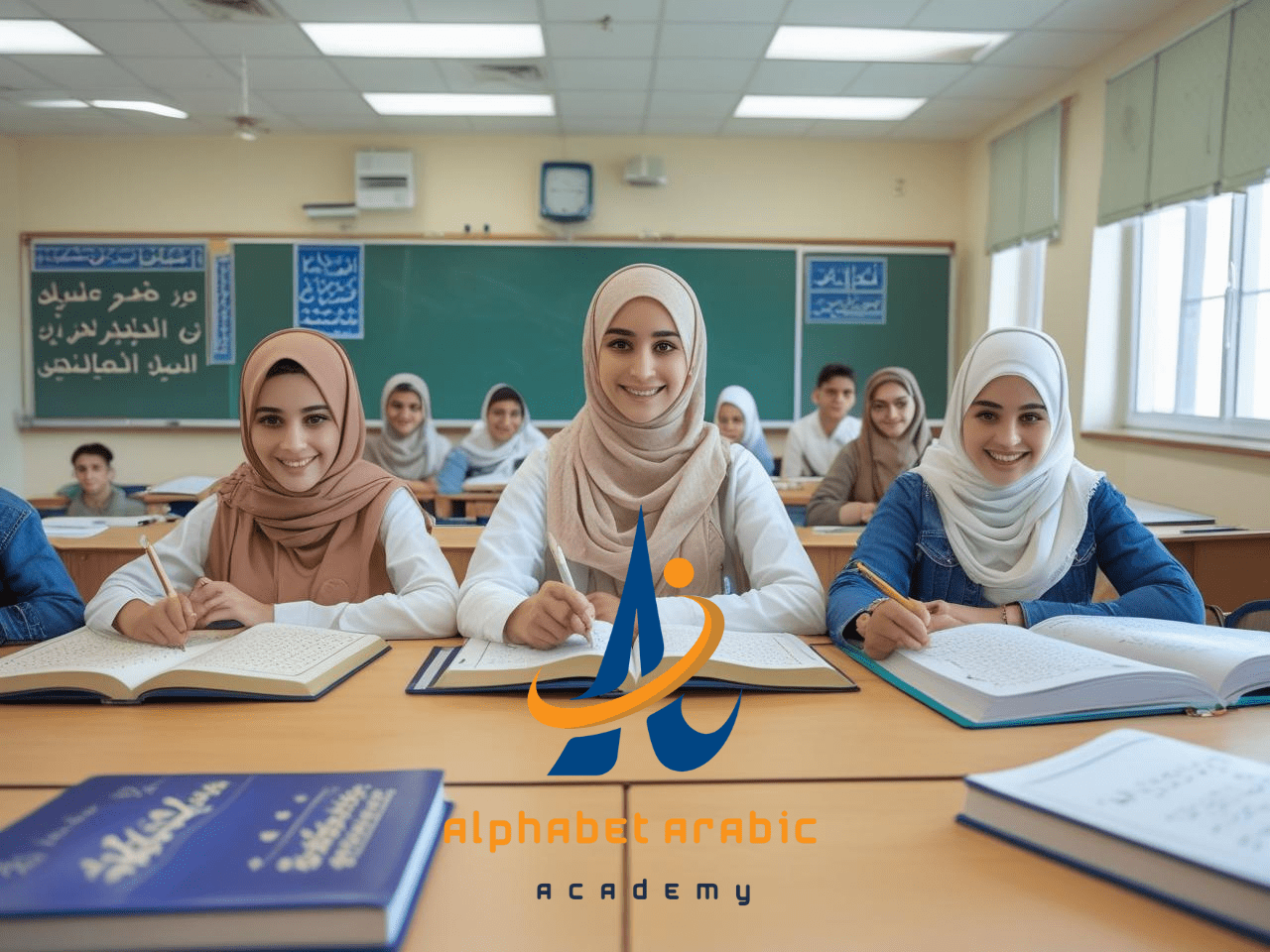
Not just “native speakers.” Teachers who were trained to teach Arabic as a foreign language — with degrees from recognized institutions. At Alphabet Arabic Academy, every instructor is a certified native Egyptian speaker with a university degree, most from Al-Azhar University or Dar El-Ulum. You can browse the teacher profiles here before you commit to anything.
Live interaction — not just pre-recorded content
University-level learning requires feedback. Real-time correction of pronunciation. Questions answered in the moment. Writing reviewed by an actual human. Pre-recorded video libraries don’t do this. Live sessions do.
Level-based progression with defined outcomes
Each level should have a clear starting point, a logical sequence, and measurable outcomes at the end. If the program can’t tell you what you’ll be able to do after 3 months, that’s a red flag.
Verified certificates
Not a PDF you generate yourself after finishing a quiz. A certificate with a unique ID, a QR code for independent verification, and a signature from a qualified academic director. That’s what a university-level credential looks like.
Cultural depth woven in
Arabic can’t be fully separated from the cultural, historical, and religious context it lives in. University-level programs integrate this. Vocabulary apps don’t.
Arabic Degree Distance Learning: What the Real Options Look Like
If you specifically want a formal degree in Arabic, distance learning has expanded significantly. Here’s what’s actually available in 2026.
Formal Degree Programs Online
International Open University (IOU) — Offers an intensive Arabic language program (IAP) fully online. Structured, affordable, and rooted in Islamic studies. Fees range from $90 to $1,050 per semester depending on study plan and country of residence.
Al-Azhar University (Correspondence Program) — The most historically prestigious option for Islamic Arabic studies. Deep roots in scholarship, best suited for intermediate-level learners already familiar with Arabic foundations. Slower-paced, traditionally structured.
Saudi Electronic University — Offers an online Arabic program for non-native speakers, structured around international standards for Arabic proficiency assessment.
University of Jordan, SOAS (University of London), and several US universities — Some offer Arabic language components through distance programs, primarily at postgraduate level or as part of broader Middle East studies degrees.
The honest limitation with formal degree programs: they’re often expensive, require significant commitment, and aren’t always designed for non-native adult learners starting from zero. They’re built for students in academic tracks, not working professionals or independent learners.
Structured Academy Programs (The Smarter Middle Path)
This is where most serious learners find the best balance.
An academy like Alphabet Arabic Academy isn’t a university — but it delivers university-level instruction through native Al-Azhar-trained teachers, a structured curriculum from A0 to C2, live 1-on-1 sessions, and verified certificates at every level.
Pricing starts from $40/month, with options for different session lengths, frequencies, and duration discounts. That’s university-quality without the university price tag or the rigid enrollment system.
Online Arabic Language Institute: What to Look For
Searching for an “online Arabic language institute” returns hundreds of results. Most aren’t worth your time. Here’s how to separate what’s real from what’s marketing.
Teacher Credentials — The Non-Negotiable
An institute is only as good as its teachers. Ask directly: Where did the teachers study? What qualifications do they hold? Are they native speakers trained specifically to teach Arabic as a foreign language?
At Alphabet Arabic Academy, the teaching team includes 47 certified instructors, all graduates of Egypt’s leading universities. Egypt has one of the strongest traditions of teaching Arabic as a foreign language — a heritage that dates back centuries and produces teachers who understand not just Arabic, but how to make it accessible to non-native speakers.
Curriculum Design — Structure Before Content
A real institute has a curriculum that builds logically. Not a collection of modules you can take in any order. Not a video library you browse at random. A sequenced program where each level prepares you for the next.
The best programs cover all four skills in every level: reading, writing, listening, and speaking. Missing any one of them creates gaps that show up later when you try to use the language in real situations.
Feedback Systems — Where Learning Actually Happens
Pronunciation errors in Arabic compound over time. If you’re mispronouncing ق, غ, or ع from week one and no one corrects you, those habits become permanent. A serious institute builds correction and feedback into every session, not as an optional add-on.
Progress Tracking and Assessment
You should always know where you are. Which level you’re in. What you’ve mastered. What still needs work. A legitimate institute tracks this — and gives you assessments that reflect real competency, not just attendance.
Online Arabic Institute: The Path to Mastery
Mastery isn’t reached by accident. It’s reached through a system. Here’s what the path looks like through a quality online Arabic institute.
Stage 1: Foundation (A0 → A1)
Alphabet. Phonology. Basic vocabulary. Simple sentences. At this stage, the goal isn’t speed — it’s accuracy. Getting the sounds right from the beginning saves enormous amounts of time later. By the end of A1, you read Arabic script and handle basic introductions and greetings.
Most learners move through this stage in 2–3 months at 3 sessions per week.
Stage 2: Communication (A1 → A2 → B1)
This is where language starts to feel real. You build vocabulary across everyday topics, start reading short articles, and hold basic structured conversations. Grammar is taught in context — not as a standalone subject.
By B1, you can handle everyday situations: travel, shopping, basic professional introductions, and reading simple news articles.
Stage 3: Fluency (B1 → B2)
Grammar becomes more complex. Vocabulary expands into professional and academic domains. You’re reading longer texts, writing structured paragraphs, and listening to authentic Arabic content — news segments, interviews, lectures.
B2 is the level where Arabic becomes genuinely useful in professional environments.
Stage 4: Mastery (C1 → C2)
Academic vocabulary. Rhetoric. Literary Arabic. Complex argumentation. Writing formal reports and essays. Debating in Arabic. Understanding cultural nuance in real-time conversation.
This is the level of the Advanced Arabic Course — designed specifically for learners who are done with the basics and ready for real intellectual challenge.
A certificate at each completed stage gives you external documentation of your progress — verifiable, meaningful, and cumulative.
The Ultimate Guide to Learn Arabic Online University Level: Practical Steps
You’ve got the big picture. Now let’s talk about what actually works, week by week.
Step 1: Know Your Starting Level
Don’t guess. Don’t assume. Take the free Arabic level test and get an honest baseline. Starting at the wrong level — whether too low or too high — wastes more time than anything else.
Step 2: Choose Your Arabic Type
MSA for academic and professional goals. Egyptian Colloquial for speaking and everyday conversation. Quranic Arabic for Islamic studies. Business Arabic for specialized professional contexts. You don’t have to pick just one forever — but start focused.
Step 3: Commit to a Realistic Schedule
Language acquisition is about consistency, not intensity. Here’s a practical breakdown:
- 1 lesson/week (4/month) — Slow and steady. Good for very busy schedules. Progress is real but gradual.
- 2–3 lessons/week (8–12/month) — The sweet spot for most working adults. Steady progress with enough repetition between sessions.
- 5 lessons/week (20/month) — Intensive. The fastest path to fluency. Ideal for full-time students or career changers.
Add 20–30 minutes of daily practice outside class — vocabulary review, listening, writing a few sentences — and your progress compounds significantly.
Step 4: Prioritize Live Instruction Over Passive Content
Watching Arabic videos is useful supplementary practice. But it doesn’t replace a teacher who hears your pronunciation, reads your writing, and answers your specific questions. University-level study requires human instruction. That’s non-negotiable.
Step 5: Track Your Level Milestones
Every 2–3 months, assess where you are. Can you do what you should be able to do at this level? If yes, progress. If not, identify the specific gap — not “I need to study more,” but “I need to work on verb conjugation in the past tense” — and fix it deliberately.
Ibrahim has lived in Britain since birth, but he chose Arabic as his second language at school. He came to us to study intensively, opting for a three-day-a-week course. He would come straight from school to continue his studies with us and share his experiences from the day as a way to practice and develop his language skills. He started studying with us at the age of nine, and now he can speak and listen to entire passages without translation, without even thinking about another language. He is my favorite student now.
Common Mistakes That Stall University-Level Arabic Learners

These mistakes are extremely common. Knowing them upfront saves months of wasted effort.
Mistake 1: Choosing a program based on price, not structure.
The cheapest option almost always has the weakest curriculum. Courses under $50/month typically rely on pre-recorded content, minimal feedback, and vague level systems. You get what you pay for — and in language learning, the cheap option is often the most expensive in terms of time lost.
Mistake 2: Skipping spoken practice to focus only on grammar and reading.
This is the most common plateau creator. Learners who focus exclusively on grammar can explain Arabic syntax beautifully — and can’t hold a 2-minute conversation. University-level Arabic requires all four skills developing together.
Mistake 3: Switching programs constantly.
Trying a new platform every few weeks feels productive. It’s not. Consistency within one structured program — even an imperfect one — beats constantly starting over with different systems.
Mistake 4: Not getting oral feedback early.
Arabic has sounds that don’t exist in most other languages. ع, غ, ق, خ — if these aren’t corrected in the first weeks, they become permanent habits. That habit then affects your comprehension when listening to native speakers, because your brain is mapping the wrong sounds.
Mistake 5: Treating “university level” as a destination rather than a standard.
University-level Arabic isn’t a product you buy. It’s a standard of depth and rigor you apply to your study. You can reach that standard through a formal degree program or through a structured academy — what matters is the quality of instruction, the consistency of your practice, and the clarity of your progression.
Who Is This For?
This is for you if:
- You want structured, academic-depth Arabic that goes beyond apps and casual conversation
- You’re studying for academic purposes — research, university applications, Islamic studies
- You’re a professional who needs Arabic for diplomacy, journalism, international business, or NGO work
- You’re serious about reaching B2 or above and want a verified record of your progress
- You want the benefits of university-level Arabic without the cost or rigidity of a formal enrollment
This is NOT for you if:
- You want to learn basic greetings for a holiday trip (a simpler conversational course is more than enough)
- You’re expecting fluency in a few weeks (Arabic takes real time — 2–4 years to advanced proficiency)
- You’re not prepared to do consistent practice outside of class sessions
Frequently Asked Questions
Q1: Can I really reach university-level Arabic entirely online?
Yes — if the program is genuinely structured, uses qualified live teachers, and includes regular assessment and feedback. Online doesn’t mean inferior. Research consistently shows no significant difference in outcomes between high-quality online and in-person instruction. The key word is high-quality.
Q2: Do I need a formal university degree program, or can an academy get me there?
A formal degree program gives you an institution-branded credential, which matters for some academic pathways. But for language proficiency — actually knowing and using Arabic at a high level — a structured online academy with Al-Azhar-trained teachers and verified certificates gets you to the same linguistic place, often faster and at lower cost.
Q3: How long does university-level Arabic actually take?
Honestly: the US Foreign Service Institute (FSI) estimates 2,200 classroom hours to professional working proficiency in Arabic. That’s roughly 2–4 years at a serious part-time pace, or around 88 weeks of full-time intensive study. Anyone promising you B2-level Arabic in a few months is not being straight with you.
Q4: What’s the difference between MSA and Classical Arabic at university level?
MSA is the modern formal language used in media, law, academia, and professional contexts across the Arab world. Classical Arabic is the historical language of the Quran and pre-modern scholarship. They share a foundation but require separate study tracks. Most university-level programs start with MSA and offer Classical Arabic as a specialized continuation.
Q5: How do I know which level to start at?
Take the free Arabic level test — it takes a few minutes and gives you an honest starting point based on actual ability, not self-assessment. It’s free and there’s no obligation attached.
Q6: Is Alphabet Arabic Academy a university?
No. It’s a structured online academy with Al-Azhar-trained teachers, a level-based curriculum from A0 to advanced, live 1-on-1 sessions, and verified certificates at each level. It delivers university-level quality and depth without the formal university enrollment, timeline, or cost. For many learners, that’s the better fit.
Conclusion

Studying Arabic at university level online is completely achievable in 2026. The tools exist. The teachers exist. The structured programs exist.
What separates the learners who get there from the ones who stay stuck is simple: they chose a real system, they committed to a consistent schedule, and they got live feedback from qualified teachers instead of relying on passive content.
You don’t need to enroll in a formal university to study Arabic seriously. But you do need structure, human instruction, and a clear progression from where you are to where you want to be.
If you’re ready to find out where you stand and which program fits your goals, start here:
👉 Take the free Arabic level test — it’s free and takes a few minutes.
Or if you already know you want structured live instruction with Al-Azhar-trained teachers:
👉 View course options and pricing — starting from $40/month, with a free first lesson and a 7-day money-back guarantee.